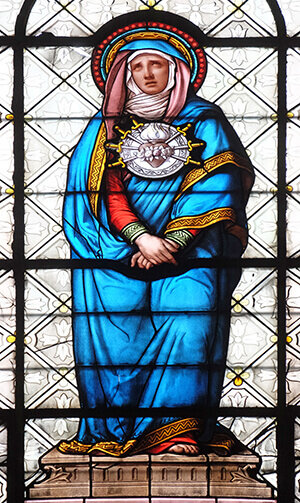
Every 15 September, we in the Congregation of Holy Cross celebrate our patronal feast: Our Lady of Sorrows. When Blessed Basile Moreau placed the entire Holy Cross Family under her patronage, he was making a profoundly theological and deeply practical choice. He did not choose Mary in the moment of Bethlehem’s joy, Cana’s celebration, or even the Annunciation’s wonder. He chose Mary standing beneath the Cross—a Mother whose heart had been pierced, yet whose faith had not been defeated.
The traditional Seven Sorrows trace Mary's journey through the mystery of Christ: Simeon’s prophecy, the flight into Egypt, the loss of Jesus in the Temple, meeting Him carrying His Cross, standing beneath the Cross, receiving His lifeless body, and witnessing His burial. But perhaps the deepest question is not simply, why did Mary suffer? It is: What did Mary discover through suffering?
Mary discovered her vocation more deeply as she accompanied Jesus through His suffering. At the Annunciation, Mary said yes to God. At Calvary, she learned what that yes would cost. Her vocation was not merely to give birth to Jesus; it was to remain with Jesus—even when she could not understand Him, protect Him, rescue Him, or explain what was happening. Simeon had warned her: “And you yourself a sword will pierce.” The sword did not destroy her vocation; it revealed its depth and paths.
This is precisely why Blessed Basile Moreau saw in Mary the model for Holy Cross. The Constitutions describe her as a woman who “bore much she could not understand and who stood fast” (C8:120). Her greatness was not that she was spared suffering, but that suffering did not separate her from Christ. This has an extraordinary message for our contemporary world. We live in a civilization where suffering is everywhere, more visible than ever: wars and displaced families, loneliness and anxiety, broken marriages, abandoned elderly people, struggling young people, refugees, poverty, violence, polarization, persecution, and a quiet epidemic of meaninglessness. We have become remarkably efficient at removing physical discomfort, yet we have not learned how to accompany the human heart in its deepest wounds.
Read more reflections by Holy Cross religious

Mary teaches us something civilization desperately needs: we cannot always remove another person’s cross, but we can refuse to let them carry it alone. At the foot of the Cross, Mary does not offer Jesus an explanation. She offers Him her presence. Sometimes that is the most Christian thing we can do. A priest sitting silently beside a grieving family. A parent listening to a troubled child without judgment. A religious remaining faithful when ministry seems fruitless. A friend refusing to abandon another during depression, failure, sickness, or bereavement. A Christian standing beside someone whom society has forgotten. These are contemporary expressions of Mary's vocation.
And there is another extraordinary mystery. Mary did not merely endure the sorrows of Jesus; she allowed those sorrows to transform her. The Cross became the place where her motherhood was explained and expanded. From “This is my Son” came the gift of “Behold your mother”. At Calvary, her motherhood opened toward the whole Church. Holy Cross spirituality therefore sees the Cross not as the quaking of mission but as the place where mission becomes sacrificial love.
This is probably the secret of Christian transformation: the wound can become a window through which God’s love enters the world. Mary's journey does not end in the tomb. The woman of Sorrows becomes Queen of Heaven and Earth. The crown comes after the Cross. Her glory is not disconnected from her suffering; it is the fruit of a love that remained faithful through suffering. This is the spirituality expressed in the Holy Cross motto: Ave Crux, Spes Unica—“Hail the Cross, Our Only Hope.”
Perhaps that is Blessed Moreau's most relevant message for our age: do not run from every cross; learn what love can accomplish through it. The world does not need Christians who merely speak about hope. It needs Christians who stand at the foot of people’s crosses and become bearers of hope, compassion, and love. Mary, Our Lady of Sorrows, teaches us that holiness is not the absence of pain. It is the transformation of pain through love; it is remaining faithful when understanding fails; it is discovering vocation in sacrifice; and ultimately, it is allowing the Cross to lead us toward resurrection.
The Seven Sorrows were not seven defeats. They were seven encounters with love. And Mary’s crown reminds us of the final truth: those who faithfully remain with Christ beneath the Cross will never have the Cross as their final destination.
Our Lady of Sorrows, Patroness of Holy Cross, teaches us to stand where Christ is suffering, to serve where hope is dying, and to believe that beyond every Calvary, God is preparing a resurrection. Ave Crux, Spes Unica.
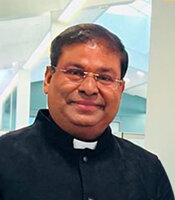
Fr. Shaji M. L., C.S.C., is a member of the Province of North East India. He has been serving for several years with the Congregation of Holy Cross in Canada, specifically in family ministries. Now, he is returning to Northeast India, where he will become Pastor of Good Shepherd Parish, Kathelcherra, which is in North Tripura in the Diocese of Agartala.